


Where most health products start
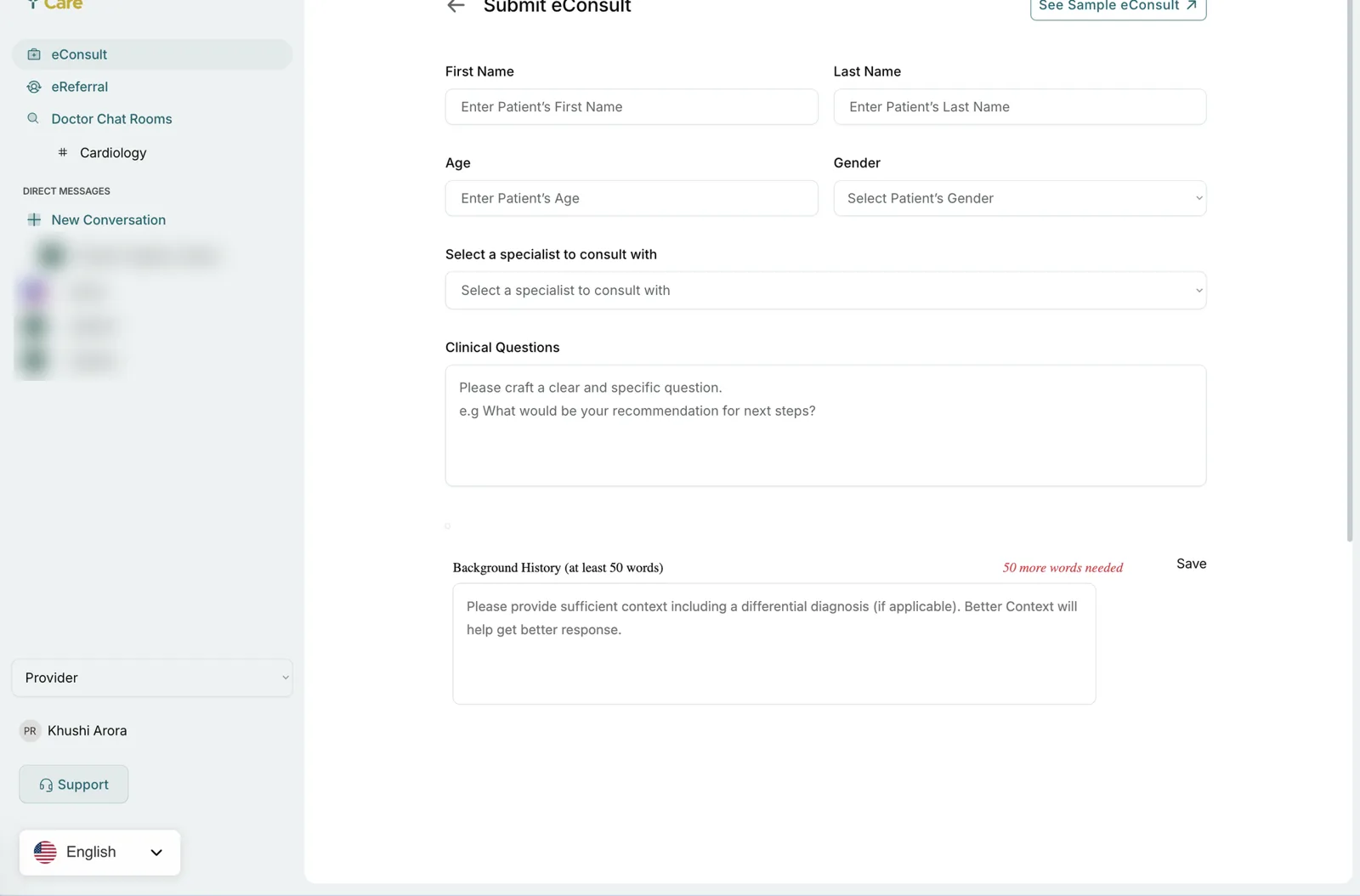
The screens in a health app are standard: accounts, forms, messages, video. What makes it work is the rules around them: who can see what, what a clinician needs before they answer, and where patient data is allowed to live. We built a health coordination platform that connected 100+ doctors across four countries with specialists.
What's different about building telehealth
The workflow is the product
Small rules decide whether clinicians use it: hiding identities in an eConsult so answers stay unbiased, or asking for enough background before a specialist sees a case.
Different views for different roles
Providers, specialists and admins each need their own view of the same case. We design roles and permissions before the screens, so nobody sees more than they should.
Compliance shapes the stack
Where patient data may live, and which vendors may touch it, depends on where you operate. We settle that in week 1, before choosing vendors, so the stack fits your rules.
Built to grow with you
Prescriptions and EHR integration can be part of the first version or plug in later. We design the core consult flow so each new layer adds on cleanly when you need it.
How it works
- 01
Scope and compliance (week 1)
On free calls we agree the core clinical flow and which rules apply where you operate, then fix the scope and price before you pay.
- 02
Build (weeks 2-5)
Consults, messaging, roles and the data layer, with working software every week. The engineer building it is the one on your calls.
- 03
Launch and support (week 6 on)
We ship to production, hand over the code, docs and credentials, and stay on for 6 weeks of support as the first clinicians use it.
Starting at $12,000
A telehealth v1 is an MVP Sprint: fixed scope and fixed price, agreed before the build. We broke down the full cost in how much a telehealth app costs.
Talk about your health product  rebuilt our onboarding, shipped our Zapier integrations, and wrote integrated plugins for our proprietary tools - all in record time. He ships better than we spec. This team is literally an extension of mine.


Work we've shipped
How we can help
Four ways to work with us - pick what fits, switch when it doesn’t.
Audits
Find what's broken - or whether AI is worth it - before you build.
Learn moreMVP Sprint
Zero to production in 5-6 weeks. A real product, not a prototype.
Learn moreRetainer
A senior engineer embedded on your team, month to month.
Learn moreCode Rescue
Vibe-coded app breaking under real users? We rebuild it to hold.
Learn moreFAQ
Frequently asked questions
How much does it cost to build a telehealth app?
A telehealth MVP with booking, video visits or consults and payments is an MVP Sprint, live in about 5-6 weeks: one fixed price, agreed before the build. Sprints start at $12,000. We scope it to what your first version needs, from prescriptions to EHR integration, and agree the price before the build starts.
Do I need HIPAA compliance for a telehealth app?
In the US, yes, if your app handles protected health information for a covered entity such as a clinic. We build the technical side to it: access controls, encryption, audit logs and vendors chosen with you. Other countries have their own rules, and we settle which apply in week 1.
Can you build for clinicians outside the US?
Yes. Our health coordination platform onboarded six hospitals and clinics across four countries, including Liberia, Ghana and Cape Verde, with a language switcher built in.
Do you build video visits?
Yes, using providers such as Twilio that offer HIPAA-eligible video, alongside async consults and messaging.
Do we own the code?
Yes, 100%. You own the code, infrastructure, docs and credentials.